


Showing posts with label Design. Show all posts
Nokia 5 review

NOKIA 5 SPECS
Screen size: 5.2inch
Resolution: 720x1280
Battery: 3000mAh
Front camera: 8MP
Rear camera: 13MP
Weight: 160g
Dimensions (mm): 149.7 x 72.5 x 8
OS: Android 7
CPU: Snapdragon 430
RAM: 2GB (3GB variant in India)
Storage: 16GB + microSD
Black Friday is now just around the corner, and a number of retailers are taking advantage of the deals season bonanza to give the Nokia 5 some significant discounts - if you're looking for something that brings a clean Android experience coupled with a decent metal design, this is a strong choice, although read our full review to see a couple of places where the Nokia 5 isn't as strong before you buy.
The Nokia 5 sits a little awkwardly, between the better-equipped Nokia 6 and eye-catchingly cheap Nokia 3.
It’s not that it’s a bad phone, but its bigger brother doesn't cost that much more, so it would be easy to chuck in a little extra cash for the 6 – or, if you’re really looking to save the pennies, you might be better off with the 3.
Don't discount it just yet though. The Nokia 5 is the best looking smartphone in its price bracket, with its all-metal body providing a premium finish that could easily be seen a more expensive device.
The 5.2-inch HD (720p) display is crisp and clear, although the colors don’t exactly jump out of the screen, while the inclusion of a fingerprint scanner on the front of the handset is a big plus adding an extra layer of security and an easy way to unlock the phone.
We’d have liked to have seen a stronger showing from the battery, with considered usage gaining you a day of use from a single charge, but gaming, video playback or music streaming will see you running out of juice by early evening.
The 13MP rear camera looks great on paper, but in practice images tend to look dull and lack clarity – while the camera app itself is sluggish. The slow performance extends to the whole device though, and you’ll need to be patient to be able to live with the Nokia 5’s load times.

Who’s it for and should I buy it?
The Nokia 5 is aimed at anyone looking for an affordable smartphone from a brand they trust – and few manufacturers can boast the history and appeal to nostalgia that the Nokia name carries.
It's especially attractive to those with a keen eye for style, but without pockets deep enough for a flagship, or even sub-flagship, device. Just because you’re paying less doesn’t always mean you have to compromise on design.
You won’t find a more premium finish on a smartphone that costs this little, and as long as you’re willing to be patient, and are less into gaming and movies and more into emails and social apps, then you’ll certainly enjoy the Nokia 5.
Nokia 5 price and availability
- Launch price (Aug 2017): £179.99 (around $200, AU$275), R13,499
- Available in UK from August 16, India from August 15 - 3GB variant in November
The Nokia 5 has been on sale since August, landing for £180 in the UK with 2GB of RAM. However, in November 2017 a 3GB variant has been launched in India, for the price of R13,499 to give it a little extra power and more choice for those that want more from their Nokia 5.
The best-looking phone in its price bracket
- Premium all-metal body oozes style
- HD display is clear, but lacks color pop
- Fingerprint scanner is nice addition at the budget end of the market
The compact form factor of the Nokia 5 is something which may sway prospective buyers towards it, and away from the bigger Nokia 6.
It’s a more ergonomic design, with the curved edges nestling comfortably into the palm, and you can reach anywhere on screen with your thumb.
Crafted from a single block of 6000-series aluminum, the Nokia 5 has a surprisingly premium construction for a phone with such a low price tag. It feels like a more expensive phone when you pick it up, and that’s great.
Another bonus of the Nokia 5 is the presence of a fingerprint scanner below the screen, which also doubles as the home navigation key. Digit readers tend to be reserved for pricier devices, so it’s good to see the tech filtering down the tiers, and especially to a device as cheap as the Nokia 5.
You can pick the Nokia 5 up in four different colors: copper, black, silver and blue.
The 720p HD display is bright and clear, giving a good level of detail to images and text alike. You can comfortably read emails, watch videos and enjoy gaming sessions on the 1280 x 720 screen.
It’s not overly vibrant when it comes to color reproduction, and if you put this LCD panel next to an AMOLED screen you’ll notice it’s duller to the eye. In isolation though, and considering the price you’re paying, it’s hard to knock the screen on the Nokia 5 too much.
Nokia 5 design gallery


Battery life
- A day of battery life from a single charge if you’re lucky
- Video and gaming really take their toll
- Charging is slow
The Nokia 5 comes with a 3,000mAh battery, which if you’re someone who doesn’t tend to game or watch video on their phone should last you a full day on a single charge.
You’re highly unlikely to get more than a day from the Nokia 5 though, with a nightly plug-in required to see you through the next day.
And if you like to use your phone for streaming music and gaming, the Nokia 5 will require a top-up come mid to late afternoon if you want it to last until bedtime.

With an average daily usage of a couple of hours of Spotify streaming, around an hour of gaming, social networking, emails, messaging and a few calls we usually found ourselves plugging in before we left work to ensure the Nokia 5 lasted the commute home and the evening.
We ran our 90-minute HD video battery test on the Nokia 5, with Wi-Fi connected and screen brightness on full, and the handset lost a huge 37% of its juice.
While you’re unlikely to watch a movie at full brightness on this phone it’s a good indication of how quickly the Nokia 5 can drain when it’s pushed; by comparison the Moto G5 lost 22% in the same test.
The phone is charged via a micro USB port on the base of the handset, but there’s no fast charging here. It means the Nokia 5 takes a while to top up, so if you’re going out for the night you’ll want to put it on charge at least an hour before heading out the door to make sure you get a decent slug of juice.
Camera
- Slow to load and focus
- Images can be muddy and lacking in color
- It suffices for the odd social post
The Nokia 5 has cameras, sure – two of them to be exact. But you’re unlikely to be winning any photography competitions thanks to them.
Round the back the main 13MP camera sounds promising on paper, but in practice it’s sluggish, and doesn’t always produce good pictures.
Even with HDR (High Dynamic Range) mode enabled we still found images could look a little dark, and a lack of detail and color was a common theme throughout our shooting experience.

If you’re patient, letting the app load up and the focus settle, you can get some decent shots if the lighting is good, and we found the Nokia 5 performed pretty well up close – but it’s far from a fluid shooting experience.
There’s no manual or pro mode to give you control over settings such as shutter speed and white balance, but at this end of the smartphone market that’s no surprise.
The app itself is simple to work out. There’s a large centralized shutter key, while quick settings at the top of the screen enable you to switch between the front and rear cameras and toggle the flash, timer and HDR settings.
You can also use the volume key to snap shots, which is sometimes much easier than hitting the on-screen button, especially when it comes to selfies.
The 8MP selfie camera on the front is good enough for the odd Snapchat and Instagram post, plus there’s a beauty mode built in if you’re not looking your best.
Camera samples gallery



Anything else I should know?
- Pure Android is clean and easy to use
- Performance is slow, but it runs everything
- Storage fills up fast, so a microSD card is a must
The Nokia 5 isn’t going to blow you away with slick performance, and that’s no surprise considering the price tag, but what it does offer is a pure Android experience.
It runs the latest version of Google’s software – Android 7.1.1 Nougat – which means it’s bang up to date, and with no heavy interface overlaid by HMD, owners of this phone shouldn’t have to wait too long for an update to Android Oreo when it launches later this year.
In fact, the latest version of Android is being offered as a beta test already, so it won't be long before you can get your hands on an updated version of the software for everyone.
The standard suite of Google applications are preinstalled, and that’s it. There’s no additional bloatware, so you have a clean canvas on which to install the apps and games you want, without ones you don’t want getting in the way.
Under the hood the Nokia 5 comes with a Snapdragon 430 chipset and 2GB of RAM, pretty much the expected setup at this price point. In terms of the performance this delivers… well, you’ll need to be patient.
Load times are noticeable, but during our review time with the Nokia 5 we didn’t find an app or game it couldn’t run. Sure, it’s not got the zip of a flagship device, but it’s a quarter of the price and it’s far from unusable.
We ran the Geekbench 4 app on the phone, and it turned in an average multicore score of 2,765. That puts it in the mix with the equally priced Moto G5 (2,377), Honor 6X (3,275) and Wileyfox Swift 2 Plus (2,073).
What this means day-to-day is that the Nokia 5 is perfectly capable when it comes to web browsing, messaging, social media and emails; and although you’ll need to be patient if you’re firing up more intensive apps or games, as this is a phone that goes at its own pace, it will still run them at a playable level.
The fingerprint sensor below the display is generally responsive, but there is a slight delay as it detects your digit and wakes the phone, and there were a few times when we had to present our finger more than once before it was recognized and the handset unlocked.

It’s good to see the biometric tech included in a low-cost handset though, and another nice addition on the Nokia 5 is Google Assistant, giving you a useful AI that can answer your questions, organize your day and update you on your commute. To launch it you press and hold on the fingerprint scanner/home key.
There is one big factor about the Nokia we need to address; the issue of storage on the handset.
There’s 16GB of space inside the phone, but 7.5GB of that is taken up by the Android system straight out of the box – leaving you with effectively half the space to actually use for your apps, games, videos, music and photos.
We had filled up this storage within two days of getting the Nokia 5, with a few large applications including Micro Machines, Spotify, Facebook and Pokemon Go all taking up a fair whack of space.
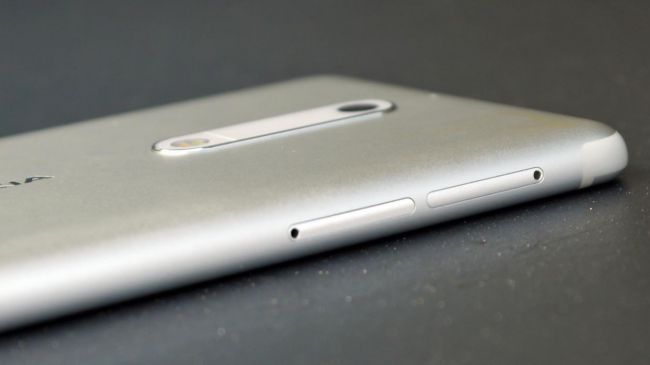
Thankfully the Nokia 5 does come with a microSD slot, a second tray on the left of the handset below the one for your nanoSIM. The phone can also ‘adopt’ the card storage, meaning it sees it as part of the internal storage of the handset, rather than an external resource, which makes saving data to the card easier and quicker.
In short, if you buy the Nokia 5 make sure you invest in a microSD card of at least 8GB.
The single speaker on the base of the Nokia 5 doesn’t produce particularly great audio, with a lack of bass and tinny sound meaning you’ll only want to use it for gaming or watching the odd video.
Its placement also means it’s easily covered by your hand when you hold the phone in landscape orientation, giving you even more reason to grab a pair of headphones and plug them into the 3.5mm jack at the top of the Nokia 5.
Video playback is passable, and you can comfortably watch YouTube videos and TV shows on the Nokia 5. You won’t want to watch a movie on the phone, though, as the smaller screen size and slightly muted colors won’t do them justice, and those who like full HD or higher resolution will be out of luck here.
You can also game on the Nokia 5, but again patience is required. Demanding games such as Micro Machines and Pokemon Go are playable, but load times can be lengthy.
Even more simple games, such as New Star Soccer and New Star Cricket, take a little time to load, but once you’re up and running the performance of the Nokia 5 doesn’t hamper gameplay – we didn’t feel like the Nokia 5 was ever negatively impacting our performance in online races in Micro Machines, for example.
The phone does get rather warm during extended periods of gameplay, and if you’re playing consistently for over an hour games can crash on the Nokia 5.
2017,
Android,
battery life,
Camera,
Design,
Nokia,
Nokia 5,
Performance,
Price,
Review,
Smartphone,
Moto G5 Plus review

Moto has announced that the G5 Plus will receive the upgrade to Android Oreo in the following months. It won't revolutionize the way you use the phone, but notification dots, a retooling of the way apps work in the background, as well as picture-in-picture mode, make for some exciting additions.
While flagship makers battle for the top spot with small bezels and pixel-perfect cameras, Motorola has been winning a more quiet, but equally important fight: to offer desired features in a phone without costing too much.
Speaking of features, the new Moto G5 Plus has them in spades. A fingerprint sensor, generous heaps of internal storage with microSD support, Google Assistant, fast charging, GSM and CDMA compatibility. The list goes on.
In that regard, it isn’t a far cry of last year's value-packed Moto G4 Plus - not that you’d even know the two were related by looking at them.
Refreshed from top to bottom (and on the inside, too), the Moto G5 Plus has redefined itself and it didn't even have to.
If you’re strapped for cash, but still want the latest Android Nougat software (with Oreo on the way), this year’s model is on sale for $229 (£249, AU pricing not disclosed at time of review), which is actually a little bit cheaper than the G4 Plus. How often do you see phone prices going down instead of up?
Previous owners and newcomers alike will find a lot to enjoy here for the price. So much so that minor exclusions like NFC (this feature is available outside of the US), the non-removable back and the so-so camera performance don’t detract much from the experience or the value. Though, if those features are absolutely key, you’ll want to spend a little more on some of the other best cheap phones.

- Starts at $229 (£249, AU$399) – cheaper than the Moto G4 Plus
- Supports GSM and CDMA networks out of the box
- Available now globally
- Even cheaper with Amazon lockscreen ads in the US
Though most will have the luxury to decide between this and the Moto G5, the plus-sized phone is the only option available to those in the US. The lack of choice is a downer, but thankfully, this phone leaves almost nothing to be desired for the cost.
In the US, it has launched at $229 for the 2GB RAM model with 32GB of internal storage. At that price, it’s slightly cheaper than the Moto G4 Plus, which offered us less for the money in the way of internal storage and a weaker Snapdragon 617 system on chip (SoC).
For $299, you can pick up the US-exclusive model that comes with 4GB of RAM and 64GB of flash storage.
If you’re an Amazon Prime subscriber, you’ll snag a discount on each model: $184 and $239, respectively. The only caveats worth mentioning here is that you’ll be fed ads on the lockscreen and each phone will have some non-removable apps. However, this significant discount will certainly be worth it for some.
Depending on where you are in the world, the configurations available differ a bit.
In the Asia-Pacific region? You have two models to choose from: one with 16GB of storage/3GB RAM and one with 32GB/4GB RAM. In Latin America, there is but one model available with 32GB of storage and 2GB of RAM. To those in Europe, Africa, and the Middle East region, the only G5 Plus available has 32GB of storage with 3GB of RAM. Confusing, we know.
In the UK, you’ll be able to snag Moto G5 Plus for £249. Last, but not least, the model is available in Australia starting at AU$399.
Thankfully, any version that you pick up is compatible on both CDMA and GSM networks. On Verizon and planning a switch to AT&T, or vice versa? You’re all set with this single phone. Feel free to swap between networks on the fly, or if you’re like me, toss in a Project Fi SIM card that works with both CDMA and GSM and get the best of both worlds.
The fact that Moto can add this broad compatibility across networks in its budget phone lineup is impressive and frankly, all other manufacturers should be taking notes.

- Revamped design makes it no longer feel like a budget device
- Borrows from the Moto Z, but carves out a confident look on its own
- Concave, multi-purpose fingerprint sensor is Moto’s best yet
The Moto G5 Plus takes affordable smartphone design to the next level with a build quality that more closely mimics that of an expensive flagship phone.
Sure, the Moto G4 Plus could be considered good looking in its own right. It was on cue with what we’d expect out of a mid-range phone rolled into a budget handset. But not everyone liked the rubberized back when they equate aluminum or glass with top-tier quality.
This phone is completely made-over and almost unrecognizable next to its previous iteration, which in just about every way is a good thing.
At 150.2 x 74 x 7.7 - 9.7mm, this new phone from Moto trims but a few millimeters from the length and width and has a similar thickness to that of the G4 Plus. Factoring in the reduction from the 5.5-inch screen down to 5.2 inches and the end result is a device that’s easier to hold in the palm.
The slim earpiece cutout and fingerprint sensor on the front borrows from the Moto Z’s styling. If anything, we prefer the feel of the sensor on the G5 Plus more because of its concave design, which makes it easier to find when you’re not looking at the phone.

Set to release in lunar grey and fine gold color options (Moto provided us with the latter for review), the bezels give off a glossy look and are complemented nicely by the metallic effect on the trim that surrounds the phone. We usually see manufacturers opting for a chamfered edge here, so it’s cool to see Moto bucking convention.
From there, the G5 Plus transitions on its back into soft, brushed metal that provides a good amount of grip while avoiding common smartphone plagues, like carrier-specific branding and attracting fingerprints. As far as buttons and ports go, the G5 Plus plays host to the usual suspects.
On the right side, you’ll find a volume rocker placed above the notched power button. The nanoSIM and microSD card slot sits atop of the device, while the micro USB port and 3.5mm jack occupy its bottom.

Sitting front and center of the G5 Plus is its 5.2-inch Full HD (1080p) screen. A phone is usually only as good as its display and thankfully, this one doesn’t disappoint.
While we take every opportunity to bash manufacturers for not taking the leap to QHD (1440p) in more expensive devices -hrm, Sony -, FHD resolution suits Moto’s latest just fine. Games with a lot of detailed art look fantastic and VR experiences with the best Google Cardboard games will look just fine with its 424 pixel-per-inch (PPI) screen.
Though, due to Google Daydream’s tough guidelines that only let in phones that have OLED screen tech running at 2K, the G5 Plus will have to keep dreaming.
Indoor and out, the IPS display was clearly readable and multimedia is more vibrant than in Moto’s previous budget entries. This is in part thanks to the new settings menu that tweaks the colors of the screen, a welcome feature for those who like to have options.
- Comes with Android Nougat, complete with Google Assistant, stock apps and Pixel-like interface. Android Oreo is on its way soon.
- Moto’s built-in software features make this phone into something unique
- Swipe-activated fingerprint sensor is awesome
Some phone makers insist on heavily remixing stock Android software, but Moto is not one of them. Following closely in the steps of Nexus and Pixel smartphones, the Moto G5 Plus does very little to stray for Google’s vision for Android Nougat.
Soon, Moto will be rolling out an update to Android Oreo, but until then, Nougat will have to do.
While the Moto G4, Moto G4 Plus and Moto G4 Play came with the Google Now launcher, the new phone’s software more closely resembles that of the Google Pixel and Google Pixel XL. Instead of an app drawer button, you simply slide a finger up from the bottom to reveal all of your apps.
Of course, you’re free to install the launcher of your choosing, but this refined user interface is at its peak and a lot of people are really going to enjoy it.
All of Google’s stock apps are here, like Phone, Messaging and Contacts. There are even a few surprises built-in, like Duo and Wallpapers and Google Assistant.
There is a little bit of Moto in the mix, too. There’s an app that is aptly titled “Moto” on the homescreen by default and it’s your shortcut to unlocking some interesting features baked into the device.

We’ve seen most of these before, like “twist to open camera” and “chop twice for flashlight”. But making its debut here is the inventive one button navigation.
Once activated, the capacitive navigation buttons that you’re used to disappear and shifts those duties to the fingerprint sensor.
To go home, quickly tap it once. To look at recent apps, tap and swipe right. Going back is a simple swipe left. Like the Moto Z, you can put the phone in sleep mode with the fingerprint sensor as a more accessible alternative to the power button. To do this, just touch it a little longer than a tap, but shorter than a long press. Sounds confusing, but it’s executed pretty well.
Once activated, the capacitive navigation buttons that you’re used to disappear and shifts those duties to the fingerprint sensor.
To go home, quickly tap it once. To look at recent apps, tap and swipe right. Going back is a simple swipe left. Like the Moto Z, you can put the phone in sleep mode with the fingerprint sensor as a more accessible alternative to the power button. To do this, just touch it a little longer than a tap, but shorter than a long press. Sounds confusing, but it’s executed pretty well.

In addition to making navigation easier with the fingerprint sensor, Moto has also implemented the Google Assistant to let you do more with your voice. You can either long press the fingerprint sensor or simply bring your phone to attention with “OK, Google”.
Lastly, Moto earns points for its smart display tech. When you move your hand over the phone, a screen lights up that shows notifications and lets you pause music. It’s a nice quality of life touch that makes interacting with the G5 Plus faster and easier.
Music, movies and gaming
- Delivers a solid multimedia experience on a budget
- 3.5mm jack and Bluetooth 4.2 support wired and wireless headphones
- Vibrant Full HD display makes movies look crisp at 1080p
- Faster Snapdragon 625 and extra RAM helps games run smoothly, too
If you want true multimedia bliss, the Moto Z is definitely the best option offered by Motorola. But that G5 Plus is certainly no slouch and in fact, it one-ups its flagship sibling right out of the gate.
Starting with music, the G5 Plus comes with a 3.5mm headset and Bluetooth 4.2 to ensure that both wired and wireless tech adopters are suited. As you may remember, the Moto Z and Moto Z Force omitted the wired option following the Apple’s controversial decision with the iPhone 7, only to bring it back in the Moto Z Play.
This device comes stocked with Google Play Music as its music player by default, but you’re free as always to load on whichever music streaming service that you’d prefer.

As it does for music, Moto’s budget device calls upon Google’s suite of video apps, Google Play Movies and YouTube to provide what you’re looking for. Like the G4 Plus, the G5 Plus a 1080p display, though it looks plenty vibrant and crisp for its size. Overall, the quality is as expected, but is nevertheless impressive considering the low price tag.
Lastly, your gaming experience on this phone will depend on the types of games you like to play. The classics work without a hitch and even newer titles, like Fire Emblem Heroes and Hearthstone, look stunning and are each a smooth, enjoyable experience on the G5 Plus.
Whatever it is you enjoy doing on a phone for entertainment, the built-in microSD slot that supports up to 128GB of extra adoptable storage will keep the party rolling for quite some time.
Specs and performance benchmark explained
- Enough power to multitask without a hitch and run the latest games
- Matches (and in some regions, exceeds) the specs of the Moto Z Play for cheaper, sans Mods
Moto’s G series has always worked against the idea that a low price phone can’t be thoughtfully constructed or packed full of competent specs, and that baton has been passed on to the G5 Plus.
You certainly won’t find a Snapdragon 835 inside, but the Snapdragon 625 octa-core SoC is a small, albeit noticeable speed boost over the 617 inside of the Moto G4 Plus. Also improved inside of that package is the Adreno 506 graphics processing unit (GPU) that operates at a higher clock speed than what was found in last year’s model.
Our review unit has 4GB of RAM inside, so it’s the top of the line in Moto’s G5 lineup in the US (and anywhere else, for that matter).

In fact, that puts it higher than the 3GB of RAM-equipped Moto Z Play if you’re just comparing specs. During our time with it, we spent no time waiting on hanging menus, and multitasking with Nougat’s split-window feature didn’t slow this phone down at all.
When put through its paces on Geekbench 4, the Moto G5 Plus spit out an average of 3,824 for the multicore score. Oddly, that’s well above the 2,600 score put forward by the Moto Z Play, which aside from the 3GB of RAM, matches this new budget phone completely. We think it’s fair to attribute this to inconsistencies in the benchmarking app and/or vast performance improvements from Nougat over Android Marshmallow. One shouldn’t place too much confidence in those scores, anyway.
Wondering where the Moto Mods are? Like you, we were hoping to see them appear on the G series one day. And thankfully, Motorola didn’t totally rule out Moto Mod coming to the budget line when we asked at MWC 2017. But seeing as this Moto G5 Plus is similarly specced to the Moto Z Play, the lack of modular support is a let-down.
- No batter increase over the G4 Plus, but that’s not a bad thing
- Impressive fast-charge technology for a budget phone
In some ways, the Moto G5 Plus couldn’t be more different from its predecessor. But when it comes to the battery inside this time around, it’s quite similar.
At 3,000mAh, the capacity offered up is on par for a phone this size. Moto promises all-day performance, so the baseline target for this budget phone is one day before it taps out. During our testing, it was common for the phone to last longer than its advertised lifespan. Obviously, your results will vary depending on your work (or play) load, but the G5 Plus easily meets the mark of a day of battery life.
It’s really no surprise, given that an 90-minute HD movie only drained 12% of the battery.
Although this phone can last quite a while without a charge, plugging it into the included charger once it’s dead reveals another neat trick: it can return to form very quickly. Equipped with Moto’s TurboPower technology, the G5 Plus went from 0-20% in 15 minutes. After another half hour, it reached 62%. And finally, it became fully charged in a total of 85 minutes.


- Captures bigger pixels, but the results don’t really show
- 4K video looks good on paper, but 1080p at 60FPS is the star here
Moto’s camera software is becoming a favorite and the app is fast to boot and capture
If you’re a numbers person, the changes in the camera department from last year’s G4 Plus might be setting off an alarm.
The rear sensor in the G5 Plus is now 12MP, moved down from 16MP. But in its stead are some worthwhile improvements that are worth the exchange.
For instance, the main camera is now capable of better low light shooting thanks to the aperture boost from f/2.2 to f/1.7. The sensor now captures larger 1.4-micron pixels in each photograph, which in theory boasts accurate lighting and cuts back on the amount of noise present.
You’ll also be able to shoot video in 4K at 30 frames per second (FPS) - 1080p at 30FPS was the threshold of the G4 Plus. What we discovered from the G5 Plus is that being able to shoot in 4K doesn’t magically turn your footage into Hollywood-caliber gold. While detailed, our results were shaky, slow to focus with colors muddled slightly throughout. There are few places where this phone shows its budget roots and this is one of them.
Lastly, though the specs of its front facing camera haven’t changed one bit, Moto has added its professional and beautification modes to this end. Now, you can modify your shots and tweak your results with both cameras of this budget device.
As someone who uses the Google Pixel XL as a daily driver and main camera, more or less, it quickly becomes apparent how far behind every other phone is. Obviously, the Moto G5 Plus is on the opposite side of the pricing spectrum and it’s unfair to compare the two directly. And while serviceable, I can fairly state that I was a little disappointed with the camera performance here.
It’s hard to expect brilliance at this low price tag, and yes, it is possible to take some nice shots if you have an eye and a steady hand for it. But you may not want to toss out your point-and-shoot just yet.
Moto has improved its less-than-stellar reputation for bad imaging in the past few years, but the G5 Plus isn’t a good indicator of that progress.
Photos were generally murky and lacked the sharp details and colors that we expected to be captured from each scene, especially considering the large pixels. Testing its low-light chops ended with mixed results. It captured photos with enough detail to satisfy, but mixed in the same haze and overblown lights that we saw during the day.
Check out the results in the slideshow below. As you’ll see, still photos are another area where the Moto G5 Plus lives up its its budget reputation, and doesn't in anyway exceed it.
 |
| The contrast doesn't pop as much as it should, but this is one of its better shots. |
Despite the so-so performance of the camera hardware, Moto’s camera software is really starting to become a favorite. It’s intuitive, feature-packed and it boots quickly, whether you launch it from the app, the twist-to-open Moto action, or by double tapping the power button.
Motorola is continuing its hot streak in the budget market with the Moto G5 Plus. Flagship features and design have slowly trickled down to the mid-range and it’s good to see Moto absorbing this trend on the low-end. Finally, it longer looks or feels like a budget phone.
While what’s at the core of the new phone is simply a welcome jump over last year’s, it will likely mark a change in perception of the G series. If not for the design, then for inclusions like Google Assistant and other inventive features like the one-button navigation on the fingerprint sensor.
The quality of the images taken with the G5 Plus are the low point here. Otherwise, our biggest gripes with it are centered around what it could be, not what we wished it wasn’t.

For those on a budget, but who don’t want to sacrifice decent performance to save some money.
Android Nougat with Google Assistant, Moto’s slick (and light) custom touches, premium design and stacked list of features all make this more than your ordinary phone. All for $229, you say? That’s an easy sell.
If you own the Moto G4, you more or less know what you’re in for. For everyone else, there is simply no better deal out there for a phone that essentially does it all.
Sure, you won’t find NFC here if you’re pining to use Android Pay in the US, and the camera performance didn’t impress us. However, those are small blips for a device that gets so much right for very little cash.
Moto G5 Review

The Moto G is currently our best cheap phone in the world, which shows you just how good this affordable handset is.
Motorola's G series is the firm's best selling phone range ever, and the latest instalment in the budget line is the Moto G5.
Manufacturer Lenovo (the new owners of the Moto brand) has decided to kick things up a notch with a more premium, metallic design and an impressive host of extras that you wouldn’t usually expect to find in a phone this cheap.
Just like last year’s Moto G4, the Moto G5 starts at sub-£200, but the plastic has given way to aluminium and there’s a snazzy fingerprint sensor now too (although the larger, and pricier G4 Plus was the first G series handset to the introduce this tech).
The Moto G5 also runs the latest version of Android, 7.0 Nougat, with some handy gestures and options via the Moto app.
But the chipset has oddly had a downgrade and the screen is smaller, so is the G5 really a worthy successor?

Moto G5 price and release date
- Starts at £170 (AU$299)
- Not available in the US
- It’s £10 more for 3GB of RAM
The basic version of the Moto G5 with 2GB of RAM is available in the UK for £170 from John Lewis, Carphone Warehouse and a handful of other retailers, while you're looking at AU$299 in Australia.
It usually comes in gold or grey, but O2 stocks an exclusive blue version. You can pay an extra £10 to get 3GB of RAM and dual SIM support if you buy online via Motorola or Amazon and we recommend that you do.
That £170 would be around $200 in the US, but the bad news is that the Moto G5 is not going to be released Stateside. Bargain hunters in the US will have to make do with the Moto G5 Plus.
Some markets will only get the version with 2GB of RAM, but our review unit has 3GB under its grey exterior, along with space for a second SIM card.
Premium for all?
- More expensive look and feel
- Great camera on paper
Lenovo’s tagline is “Premium for all” and that idea is immediately apparent in the design of the Moto G5.
While the Moto G series has always been lauded for packing great specs into affordable handsets, it has never been known for style. That changes with the Moto G5.

This is a good-looking phone with a satisfying heft, thanks to the aluminium rear panel. It has a seriously slick, indented fingerprint sensor below the screen on the all-glass front, with a subtle sliver of metal around the speaker at the top.
A silver circle surrounds the large camera module on the back with a classy M logo etched into the metal panel. This is easily the most attractive Moto G we’ve ever seen.

It also boasts a 13MP main camera with phase detection autofocus and a 5MP selfie camera with a wide-angle lens for group shots. That’s an impressive set of specs on paper.
Throw in rapid charging and the usual suspects in terms of connectivity and it’s clear the Moto G5 brings a lot to the table. At first glance, the only obvious omission here is NFC.
Premium for all indeed.

Design and display
- Classy gleaming metallic frame and brushed metal finish
- Decent 5.0-inch 1080p display
While the design of the Moto G5 is impressive, it’s not going to catch your eye in the way that something like the Samsung Galaxy S8 will. We can say it looks good, but we always have to add the qualifier “for the price”.
If we compare it to last year’s Moto G4, which was all plastic and lacked a fingerprint scanner, the forward strides are obvious.
The metallic back looks and feels nice, and the metal panel gives way to a plastic bumper section at the top and bottom, which will be more durable in the event of a fall.
It's not, however, as premium as the Nokia 5 and Nokia 6, which boast full metal bodies crafted from a single piece of aluminium.

On the bottom edge, you’ll find the micro USB port and a small indent to help you prise the back off to reveal the removable battery, SIM slots, and the microSD card slot (up to 128GB).
There’s a standard 3.5mm headphone port up top and the right spine has a smooth volume rocker with a textured power button below it.

On the glass front, there’s the front-facing camera and speaker at the top, with a Moto logo, and at the bottom there’s the concave fingerprint sensor and microphone.
The display is a 5-inch IPS LCD with a resolution of 1920 x 1080 pixels. It’s sharp, in fact, at 441 pixels per inch, it’s a touch sharper than the display on the Moto G5 Plus. It’s also bright and vibrant and will serve you well for reading, watching videos, or gaming.
The big bezels around the screen are one of the few clues that this is a budget phone, but you can’t have everything.
Interface and reliability
- Near stock Android but with a handy Moto app
- Slick fingerprint sensor can replace nav buttons with swipes
- Runs Android Nougat complete with Google Assistant
It’s nice to see the latest, near stock Android 7.0 Nougat on the Moto G5, and we’re glad Lenovo has gone with Google’s suite of apps. Chrome is a solid browser, Photos allows you to automatically back up your precious pictures and videos, and there’s simply no need for the inferior duplicate apps that a lot of manufacturers include.
Android is slick, attractive, and accessible nowadays, with plenty of useful features baked in, so there isn’t any need for a lot of extras on top. It’s quick and easy to navigate around on the Moto G5 and we had no problems with the interface.
If you’ve used Android before, everything will be familiar. The settings and notification shade are the same as stock, the only major interface tweak in this version is the fact that you swipe up from the bottom dock to open your app drawer.

What Lenovo has added is mostly good. The Moto app gives you the ability to use some handy gesture shortcuts and have the display show basics like the time without you having to bring the full screen to life. We’ll go into detail on the camera app later.
The star of the show here, without a doubt, is the fingerprint sensor with something Lenovo calls “One-button nav”.
It allows you to reclaim some screen real estate by removing the on-screen navigation buttons and using the fingerprint sensor instead. Simply tap it to return to the home screen, swipe left to right to go back, or right to left to open recent apps.
Movies, music and gaming
- 5-inch display is crisp and colourful
- Speaker sounds terrible, but there’s a 3.5mm headphone jack
- Snapdragon 430 is not the smoothest for gaming
While it isn’t going to blow you away, the Moto G5’s 5-inch screen is perfectly adequate. We didn’t have any issues reading or watching videos on it.
Crank the brightness up outdoors and it remains legible. It doesn’t hit Super AMOLED highs, but the colours look convincing enough and it works just fine for YouTube or Netflix.
The single speaker is an obvious weakness. It sounds tinny and rumbly and it vibrates the Moto G5 if you turn the volume up beyond halfway.
That’s not much of a surprise in a budget phone, but you will definitely want to use the 3.5mm headphone port for listening to music or enjoying movies.

For casual gaming, the Moto G5 will suffice. We had no issues with Super Mario Run, for example, but Asphalt 8 didn’t fare quite as well. We were able to play on the highest graphical settings, but it did drop frames from time to time. The loading speeds for games were also quite slow.
One issue that you might bump into, especially if you like to load movies or music onto your phone or install big games, is the lack of storage space.
The Moto G5 has a 16GB capacity, but only 10GB is available out of the box. Thankfully, there is a microSD card slot that supports cards of up to 128GB.
Benchmarks and performance
- Plenty of power for basic tasks
- A little slow to load and quit apps and games
The Moto G5 pairs a Snapdragon 430 chipset with an Adreno 505 GPU. It feels like enough power for the majority of basic tasks. Browsing the web, typing messages, and swiping around is hitch-free, the only time we felt any lag was coming in and out of apps and games. It’s a little slow to load and a little slow to quit.

Our Moto G5 review handset is the 3GB version, and we’d definitely advise spending the extra £10 to get it. We suspect the app switching delays will be worse on the 2GB model.
With an average score of 2,377 in our Geekbench 4 test, the Moto G5 disappointed us a little. Last year’s Moto G4 managed to score 3,104, and the Moto G5 Plus hit 3,824 in the same test. The Honor 6X scored 3,275.
But the Moto G5’s score isn’t that bad. The slightly more expensive Wileyfox Swift 2 X has the same chipset and 3GB of RAM and it only managed an average of 2,016.
Battery life
- The rapid charging is very fast
- Daily charging is required
The battery life of the Moto G5 is typical. On a normal day of mixed use, you’re going to want to charge it up at night. We never dropped below 10% before bedtime, even on a busy day of shooting photos and gaming, but it also never lasted beyond a day and a half.
At the end of our 90-minute HD video test the Moto G5 had lost 22% of its battery power, which is a perfectly respectable result, though not quite as good as its predecessor, which only lost 17%.
That might be explained by the fact that Lenovo has shrunk the capacity slightly from 3,000mAh to 2,800mAh, though it has also shrunk the display by half an inch.

Gaming tends to drain batteries quite quickly and that’s true for the Moto G5. It lost 8% in 20 minutes playing Asphalt 8, and 7% in 20 minutes of Super Mario Run.
The 10W rapid charger is impressive though. If the battery is low it climbs extremely fast, but it slows down as the percentage ticks up. Just 20 minutes plugged in was enough to go from 20% up to 50%.
Overall, Lenovo’s claim that you can get hours of power in minutes of charging holds up.
Camera
- Low light performance is poor
- Camera app includes a professional mode
- 5MP wide-angle front camera is good for group selfies
On paper, the 13MP main camera in the Moto G5 sounds impressive. However, it doesn’t have the dual-LED flash of its bigger brother, the G5 Plus, or the large f/1.7 aperture which improves low light performance.
The G5 Plus camera may only be rated at 12MP, but it’s a superior Sony IMX260 sensor.
The camera in the Moto G5 is decent, but unremarkable. In good lighting conditions, when you take your time, it’s possible to capture some stunning shots. The off-the-cuff performance, which is how most of us really use our cameras, is not as good.
If there’s any movement, then shots come out blurry, and noise creeps in when there’s anything less than bright daylight.

The Moto G5 does have the same camera app as its more expensive Plus variant though. It’s straightforward to use and supports automatic HDR. You can tap and hold to lock in a subject to focus on and there’s a brightness wheel around the reticle.
There’s also a professional mode, which lets you adjust ISO, white balance, and a few other bits and pieces. Slow motion and panorama are present, too, but neither is very good. Video recording is basic at up to 1080p and 30 frames per second.
The 5MP front-facing camera has a wide-angle lens for group selfies and we like the option to tap anywhere to capture, so you don’t have to do contortions to reach the shutter button.
Camera samples
 | |
| The camera captures a fair bit of detail close up, but you can see the noise creeping in because it’s indoors. |
 | |
| Ideal lighting conditions allow for detailed, vibrant, colourful shots like this. |
Verdict
If you’re not willing to take a chance on an unfamiliar brand, then the Moto G line remains the best value Android smartphone in town.
There are significant improvements over the Moto G4 in terms of the design, with the shift from plastic to metal. The inclusion of an excellent fingerprint scanner is also very pleasing, as is the rapid charging capability.
However, the Moto G5 has taken a small step back in terms of performance, as battery life and processing power are merely average.

Who's this for?
Anyone on a budget who still wants a decent level of performance and a handset that they won’t be embarrassed to pull out of their pocket.
The latest version of Android, along with a solid build, camera and fingerprint sensor make this great value for your £170 (around $200, AU$275), though we think it’s worth stretching to £180 (roughly $220, AU$290) for the extra 1GB of RAM.
Should you buy it?
There isn’t a better Android smartphone in the sub-£200 price range, so if that’s your budget, then yes, you should buy the Moto G5.
If you want to play demanding games, or you’d like NFC for mobile payments, then you’re likely going to have to spend a fair bit more.
The Moto G5 is one of the very best phones you can get at this budget, but the following three are great options if you're up for spending a little more or less.
Moto G5 Plus

There wasn’t a great deal of difference between the Moto G4 and Moto G4 Plus, but this year’s siblings have more to separate them. The G5 Plus costs £250.
The metal design and the excellent fingerprint sensor are almost the same, but the extra £80 buys you the superior Snapdragon 625 chipset with the Adreno 506 GPU, a slightly bigger 5.2-inch display, and 32GB of storage.
Perhaps most importantly, the G5 Plus has the 12MP Sony IMX260, f/1.7 camera, which is much better than the G5’s camera in low light conditions. It’s actually the same camera module that’s in the Samsung Galaxy S7, though it doesn’t hit the same highs.
The G5 Plus also has a bigger, 3,000mAh battery, which seems to outlast the G5 based on our testing.
Read our full Moto G5 Plus review
Moto G4

Last year’s Moto G will be available even more cheaply now and it might prove to be more tempting for bargain hunters than the G5. The G4 has a bigger 5.5-inch screen, better battery life, and a faster Snapdragon 617 chipset.
Lenovo has put some effort into giving the Moto G5 a premium feel, but the fingerprint sensor is by far the best addition. It’s something that was completely absent from the Moto G4. However, the Snapdragon 430 feels like a compromise and we would have preferred to see the same Snapdragon 625 that’s in the Moto G5 Plus.
If money is tight and you prize performance over style, then there’s a case for buying the Moto G4 instead of the G5.
Read our full Moto G4 review
Honor 6X

The Honor 6X, from Huawei, is definitely worth considering in this price bracket. It costs around £230 and it also has a metal body with a good fingerprint scanner, though it’s on the back with the Honor 6X.
To tempt you further, there’s a 5.5-inch full HD display, an octa-core Kirin 655 chipset, and 3GB of RAM. As if that wasn’t enough, Huawei also throws in 32GB of storage, a big 3,340mAh battery, and a dual 12MP and 2MP main camera, with an 8MP selfie camera.
If you can find the extra £50 or so, then the Honor 6X is a compelling alternative.
Read our full Honor 6X review